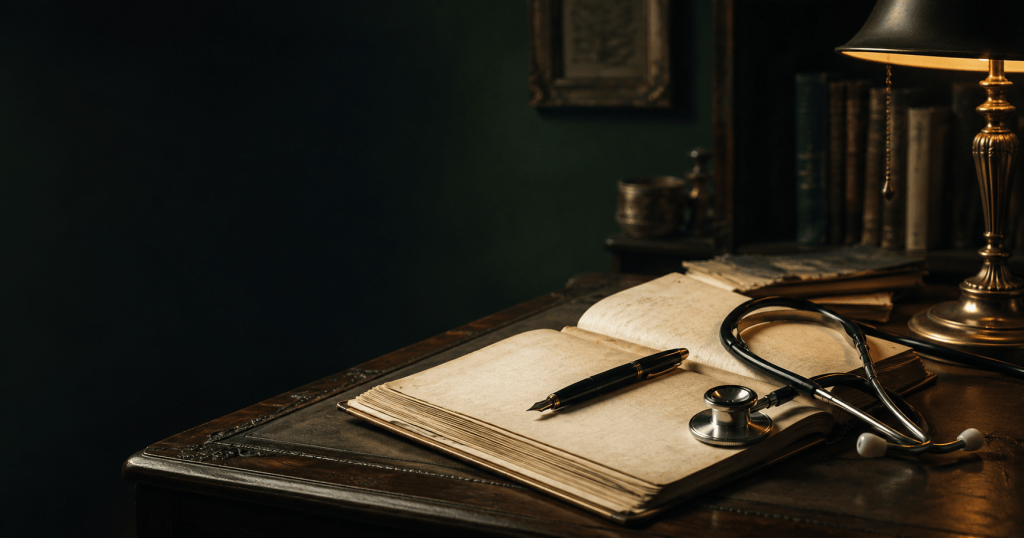
I have often said that medicine taught me to observe people, while literature taught me to understand them. It sounds very neat when written in one sentence. Life, of course, arranged it far less neatly.
I would like to say that I always knew I would become a writer. It would make an admirable origin story, but it would not be entirely true. What I did know, even as a child, was that books mattered to me.
I was born and raised in Belgaum, in a close-knit family where books were not decorative objects placed on shelves to make a room look respectable. They were read, discussed, passed from one person to another and returned—sometimes rather reluctantly. My father, grandfather, uncle and cousin all encouraged my reading, each in their own way, and somewhere among those books, I began writing.
At first, as most young writers do, I wrote because I enjoyed the sound of words and the private thrill of creating something that had not existed before. I wrote poems, stories and pieces that I am quite certain appeared far more profound to me then than they would now. Yet those early efforts taught me something important: writing allowed me to look at ordinary life twice—once while living it and again while trying to put it into words.
Medicine came later and demanded an entirely different kind of attention.
An ENT surgeon must listen carefully, in every sense of the word. A patient rarely arrives with a symptom alone. They bring fear, impatience, hope, embarrassment, family histories, half-remembered advice and, increasingly, the results of an internet search conducted at an alarming hour. The body tells one story; the person living within it may tell another. A doctor must learn to attend to both.
Medicine also has very little patience with vagueness. It trains the eye to notice what is altered, the ear to recognise what is unsaid, and the mind to distinguish the significant from the merely distracting. Literature asks for much the same discipline, though it permits more metaphors.
Over the years, the doctor and the writer within me stopped occupying separate rooms. Medicine sharpened my observation; literature widened my compassion. One showed me how people endure pain. The other made me wonder what that endurance costs them.
Even while practising medicine, I continued to write—poetry, short stories, humour, essays and literary articles. I also had the privilege of serving first as Scientific Editor and later as Executive Editor of The CheckUp, a lifestyle magazine created for healthcare professionals. Editing taught me another form of listening: listening to what a piece of writing was trying to become, even when it had not quite found its shape.
My debut novel, The Compromise, was published in 2024. It was followed by my poetry collection, Stars Without a Sky. The two books are different in form and temperament, which is perhaps fitting. I have never found it particularly easy—or desirable—to remain confined to one literary room.
And yet, beneath the different forms and subjects, I gradually began to recognise the questions that followed me.
What do we owe the people we love? What survives when circumstances compel us to abandon something essential? How much of our identity belongs to us alone, and how much has been entrusted to us by those who came before? What do families remember? What do communities choose to forget? And what happens when history records the conqueror more carefully than the displaced?
My interest in these questions did not arise suddenly. I grew up reading Amar Chitra Katha, the Indian epics, the Puranas, folklore and history. These were not merely grand tales populated by gods, kings, sages and warriors. They contained intensely human dilemmas: duty set against desire, love tested by separation, pride followed by consequence, and faith asked to survive doubt.
As the years passed, I became increasingly interested in the space where mythology, history and lived memory meet. The past is rarely as distant as dates in a textbook make it appear. It survives in family customs, in the placement of a lamp, in a prayer remembered imperfectly, in the name of a village someone left generations ago, and in stories repeated at the dining table until nobody quite remembers who first told them.
Goa became one such landscape for me.
For many, Goa is a place of beaches, holidays and cheerful abandon. That Goa certainly exists, and I do not object to it. But the Goa I had known through childhood journeys, family associations, temples, rituals and remembered routes carried another presence beneath the familiar landscape. Behind the postcard was an older Goa—layered, wounded, devout and astonishingly resilient.
My curiosity about that older world gradually became research. Research, as writers discover, has the inconvenient habit of answering one question by presenting five more. I began reading about the sixteenth-century Saraswat community, the Portuguese conquest of Goa, temple migrations, forced departures and the many quiet ways in which people preserved their spiritual and cultural inheritance.
Somewhere during those years of reading, questioning and returning to the same histories, a novel began to take shape.
Sambhavami Yuge Yuge emerged from that journey. Set against the Portuguese conquest of Goa, it explores faith, exile, memory and the resilience of a community determined to preserve what it holds sacred. It is historical fiction, but it is also concerned with questions that remain painfully contemporary: What survives when people lose their homeland? Can faith remain compassionate while under threat? What does cultural preservation demand from ordinary individuals—particularly from women, whose sacrifices history has so often recorded only in passing?
This journal is not intended to be solely about one book. Nor do I wish it to become a solemn procession of historical facts. Heritage, after all, has survived wars, migrations and centuries of human folly; it can certainly withstand the occasional laugh.
I hope to write here about literature and storytelling, Indian history and mythology, faith and folklore, Goa and cultural memory. I will also return to childhood roads, family recollections, temples, books, people and places that have stayed with me for reasons I did not always understand at the time.
Some posts may emerge from research. Others may begin with a memory—although memory, as we all know, is a charming but occasionally unreliable narrator. I may write about the craft of shaping history into fiction, the books that formed me, the rituals we inherit without questioning, and the moment when an ordinary experience quietly becomes a story.
Above all, I hope this can remain a place of curiosity.
We live in an age that encourages immediate opinions, preferably expressed before one has had the inconvenience of thinking. I find myself drawn instead to slower questions: the kind that accompany us for years, alter as we do and refuse to provide tidy conclusions.
Perhaps that is why I continue to write.
Medicine taught me that every human being carries a history within the body. Literature taught me that every history contains lives that cannot be reduced to facts alone. Writing allows me to stand somewhere between the two—to observe, to imagine and, when I am fortunate, to understand a little more than I did before.
This journal is where I hope to bring those worlds together: medicine and memory, history and imagination, faith and inquiry, the personal and the inherited.
Some of these journeys will lead us into books. Others will take us along remembered roads, into temples, forgotten histories, family stories and landscapes that continue to live within us long after we have left them.
I hope you will walk some of them with me.


Leave a Reply