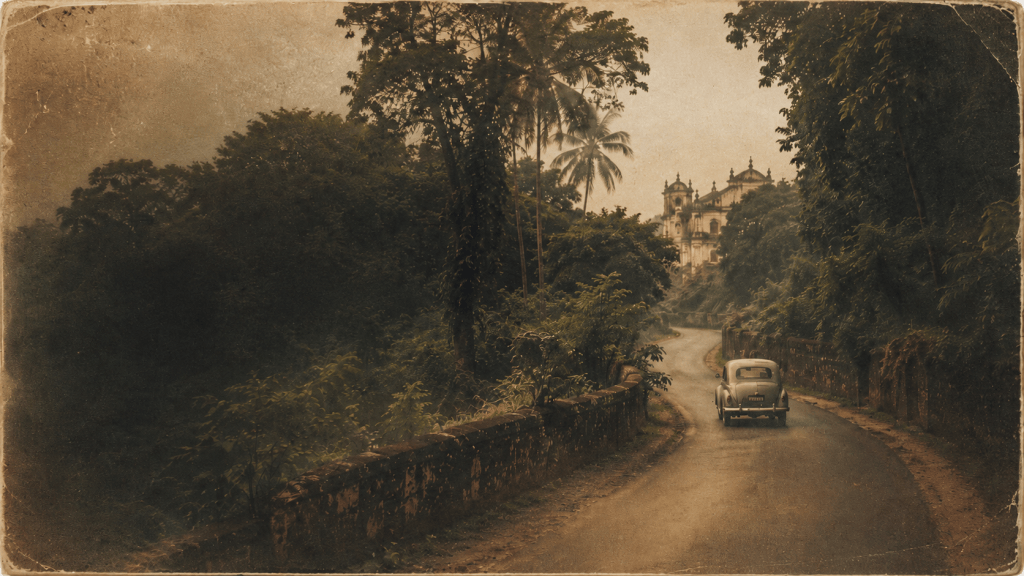
With age comes wisdom, they say. I don’t know whether I can safely comment on that, but I do know that age definitely brings nostalgia. Of late, I have found myself growing increasingly maudlin about the journeys of life, especially those undertaken in the past, when I could safely ensconce myself on a comfortable lap or wedge myself into the narrowest of crannies by the window of a vehicle, all set for a road trip.
Travel in those days was fun in a way that is difficult to describe. The roads were narrow, winding and lonely, and many existed more convincingly in the minds of map-makers than on the ground, having disintegrated into a potholed morass many a weary kilometre before their destination. The vehicles were, of course, in a class of their own—of such unprecedented vintage that their original designers themselves had probably forgotten whether they had a hand in the dubious pie of their manufacture.
We packed ourselves into them like so many sardines in a tin, sharing the road with bullock carts, pedestrians, dancers, caravans of donkeys and everything in between, all ambling along at their own pace and in their own sweet time. Small wonder that my cousins visiting from the USA—that land of rarefied road-safety rules—called our trysts with Indian roads an “adventure” rather than the far more pedestrian “drive”!
Some of my earliest and most memorable adventures were road trips to Goa, Sawantwadi and Vengurla in our vintage 1947 Ford, accompanied by sundry family friends with wailing little children, relatives of all shapes and sizes with personalities and voices to match and, what stands out most vividly in my memory, a strange Shikari Shambhu-like character carrying a large gun. I think I had found the answer long before the popular question—“Kahan se aate hain ye log?”—was dreamt of!
And Goa was different.
While half the population of India now seems to descend on Goa like a swarm of locusts with the advent of Christmas and New Year, we descended quite literally—since it was only a descent of a mountain away—whenever we felt like it or whenever a family occasion demanded. But the Goa of my childhood was rather different from the one most travellers sought.
Our trips were strictly in pursuit of spiritual succour. The state popular for its golden beaches, golden tans and golden drinks also housed the many golden temples of our family deities—golden in this case because of their gleaming cupolas, not to be confused with the Golden Temple of Amritsar.
Thus, my association with this tiny haven remains decidedly puritan. Much later, I attended an award ceremony for the better half in Goa, replete with wine and song. Old memories die hard, and the first thing that sprang to my mind on hearing the choice of venue was, “How on earth are they going to party in a temple?”
Added to this was the fact that half my family is from Goa, all possessed of a remarkably religious bent of mind. Thus, even though I cudgel my brain, what comes to mind are days spent in the dark, humongous sancta sanctorum of temples, clad in silk clothes and trying to quieten a tummy wailing in hunger while it awaited the completion of various rituals; living in the rather scary rooms of the agrashalas or temple choultries, with their moody taps, moodier mattresses and bugs of every conceivable variety; or staying in the old Goan-style houses of various aunts and uncles.
The latter packed quite a punch by way of large hall-like rooms, oddly shaped staircases, heavy doors and windows, yet were filled with a warmth that only innocence can bring. Nothing could beat the feeling of bonhomie with which our entourages were enthusiastically greeted, whatever the time of day or night. Delicious meals of fresh fish and rice were served up in a jiffy, making me wonder at the skills these domestic goddesses must have possessed, considering that their kitchens were manned the old-fashioned way with wood-fired stoves, stone mortars and pestles, and other quaint equipment that might make modern pretenders swoon with ecstasy but must have been a nightmare to use in real life.
The banter and insults traded by the large extended family were our way of bonding, of staying in touch in the only way we knew, in a world still innocent of WhatsApp and social media. Life, like the roads on which we travelled, was riddled with potholes, unvarnished and rough around the edges, but it was real.
One of my cousins married into a Goan family of great repute, and the journey for her wedding was a free-for-all carnival of sorts, with vehicles of all shapes and sizes forming a strange kind of convoy, racing each other along the single-lane tar road which, aiming at greater things, called itself National Highway 4A. The residents of the forests of Anmod and Londa must have been driven from their green beds by us strange creatures, who kicked up enough dust to give them the allergies of a lifetime.
The wedding itself was pretty memorable, taking place as it did in the grand hall of the temple of our family deity, with family priests and other heavyweights in due attendance. All I remember, however, is the post-wedding dance performance—totally unsolicited and impromptu—which a couple of cousins and I, all ranging in age from three to six years, performed in front of the palanquin of the family deity when He was brought out of the temple in procession, as was the custom every Monday.
It was a performance that must have remained etched in, and permanently scarred, the collective memory of the temple for all time to come. The head priest must have lost a decade of his life and was probably still shaking his venerable head over the fact that the parents of the day had allowed young innocents to dance wildly before the Lord of Dance Himself.
Another journey that stands out is the annual Maghi Poornima trip to the temple. The annual temple fair and Rathotsav, or chariot festival, took place in the wee hours, and the sight of the long road lit only by the flickering glow of the car’s headlights on the mad, midnight four-hour dash to Goa still sends a delicious shiver down my spine. Then there was the time when we housed ourselves in the verandah of the local school with impunity, since everywhere else was chock-a-block with devotees, and the occasion when everyone fell over themselves—quite literally—to prostrate before the advancing palanquin of the deity.
There were visits to the beaches too, but more in the fashion of something that had to be done as a formality rather than as the purpose of the visit. The Goa that remained with me was elsewhere: in the sound of temple bells, the glow of golden cupolas, the bustle of agrashalas, the smell of food emerging from wood-fired kitchens and the certainty that, wherever we arrived, someone would be waiting with a meal.
The memories are too many to recount. The visits dwindled as childhood receded and life became busier, but perhaps distance has a way of burnishing what time cannot erase.
Goa changed too.
The quiet roads of memory grew busier. Resorts, beach shacks, adventure sports, plantation trails and everything else designed to lure the traveller transformed Goa into a global destination. The old and the new began to live side by side: the Goa celebrated on travel brochures and social media, and another, quieter Goa which seemed to withdraw a little further from sight.
But old habits die hard. I still find myself seeking the familiar comfort of its temples. The roads may be wider, the hotels grander and the traveller more sophisticated, but somewhere beyond them remain the temple courtyards and bells, the forested hills, old homes, familiar rituals and the intangible sense of having returned to something that knew me long before I knew myself.
Perhaps that is what childhood journeys really leave us—not merely memories of where we went, but invisible roads leading us back to who we were. I had thought the Goa of my growing years survived only in memory. Instead, I discovered that it had been quietly travelling with me all along.
Returning this time felt different. The salt and sea air stirred something deeper than nostalgia—a sense of belonging, and the growing conviction that this ancient land held timeless stories, stories that belonged to every age.
Stories the world needed to hear.
Perhaps some memories do more than linger. They wait for the right moment to become stories themselves.
And lately, one such story has been finding its way onto my pages.


Leave a Reply