Any journey towards one’s roots is special. Like the ocean that returns again and again to wash the shores of one of India’s tiniest states, it is a return after a season of receding.
In a way, Goa is home for me. Always has been. I never lived here, but my ancestors did. Circumstances made them leave, but their deepest faith remained rooted here, in the ancestral temples which still nourish generations scattered across the world.
They are lodestones to the filings we now call the diaspora.
Tucked away in central Goa lies Ponda, a little less known than the famous beaches, and perhaps all the more precious because of it. Here, several temples of my community, the GSBs, dot the countryside, their spires rising calmly from lush groves like lighthouses guiding the final miles of those rowing wearily towards a shore they know exists somewhere in the fog of everyday life.
It has been two long, weary years since I was here. Two years of restlessness, of churn, of constantly feeling pulled off course even when everything seemed to be going right.
The car ride from Panaji seems too long.
Not because a visit to the temples can cure everything, but because I know the ground will steady for a while; the soil humming with something ancient, vast and familiar.
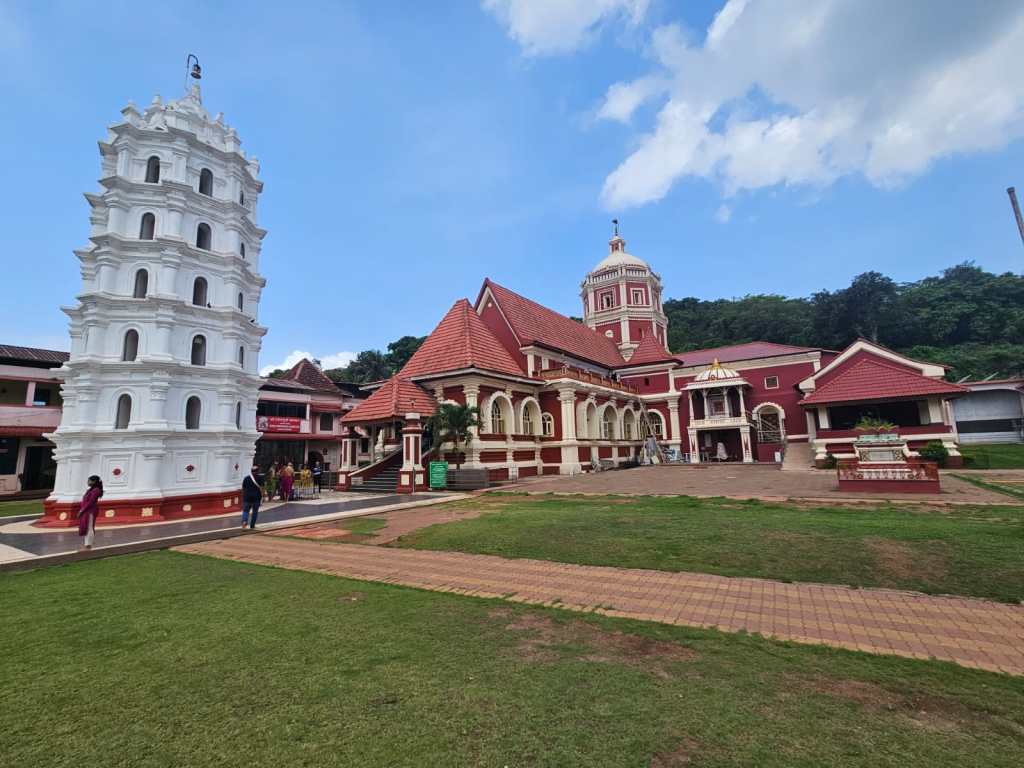
The Shantadurga temple in Kavlem is the first stop. Not surprising, because She is the Kuldevta, the clan Goddess. The one to whom generations before me have bowed and those to come will continue to.
Since it is June, the temple is quiet.
I buy an oti, the traditional offering of coconut, a khun blouse piece, haldi-kumkum, bangles, a shevanti veni and agarbattis before making my way inside.
Bakula flowers stop me on the way. Tiny and star-like, carrying the fragrance of childhood. I buy the garland while my daughter looks at these strange creamy flowers with incredulity that something so small and fragile can move her normally staid mother so much.
We walk in slowly.
What strikes me first is the peace. The assembly hall is almost empty.
And then She catches my eye.
Standing quietly.
Like the Mother that She is.
Since it is morning, She is not in Her full glory. Not yet. The ceremonial murti has been removed, and the small gold murti covering the original stone one gazes out of the sanctum.
That older murti carries within it another story. It was brought here from Keloshi five centuries ago, when changing times forced communities to carry their deities away from their original sacred spaces and rebuild elsewhere. Perhaps that history speaks to me differently now, when faith, displacement and the stubborn survival of memory have begun finding their way into the story I am writing too.
But here, before Her, history becomes something simpler.
A true Mother who rushes to meet Her children when they come home calling for Her. Just as She is: unadorned, a little askew.
Real.
The silver abhishek patra hangs quietly above. Its steady drip falls with precision.
A lesson in patience.
Life lived in the spaces between one drop and the next, each received in its own time.
The priest’s voice is a low hum as he carries out the rituals. The words and cadence are familiar. The invocation, the identification—not that She doesn’t know—the asks.
And for the first time I feel slightly ashamed.
The asks…how many of them.
And then suddenly I don’t.
Because whom else can I ask? Whom does a child turn to first, with certainty, knowing it will be heard?
Before I know it, the rituals are over and I am circumambulating the sanctum through the parikrama corridor.
Long, quiet, cool.
Each footstep carries continuity.
Other feet have trodden this very stone before mine, perhaps carrying the same tired heart. And they have been received too.
Just as they were: adorned or not, with hands open or closed.
Perhaps some of those earlier footsteps belonged to people who knew a very different kind of uncertainty. People who had watched familiar sacred spaces become unsafe, who carried what they could—including the deities at the centre of their lives—and began again elsewhere. They rebuilt temples, homes and communities around what they refused to leave behind.
Standing here centuries later, I realise that I am part of the answer to their faith.
They carried Her to safety so that someday descendants they would never know could still find their way home to Her.
And as I sit in contemplation before Her, I no longer long for anything.
Except to come here time and again. Just for the Mother to call me back to Her feet.
When my feet finally lead me down the sloping path towards the waiting car, I know that the roots I thought I had come looking for were never entirely lost. They had merely travelled—through people, memory, ritual and faith—waiting to take hold again.
Perhaps that is why this journey has stayed with me.
Because the story of people carrying their faith through displacement, rebuilding what was threatened and finding belonging again is not only a story of the past. Somewhere along the way, almost without my realizing it, those same questions of faith, displacement and return found their way into a new story of my own—one I am now preparing to send out into the world.
───


Leave a Reply