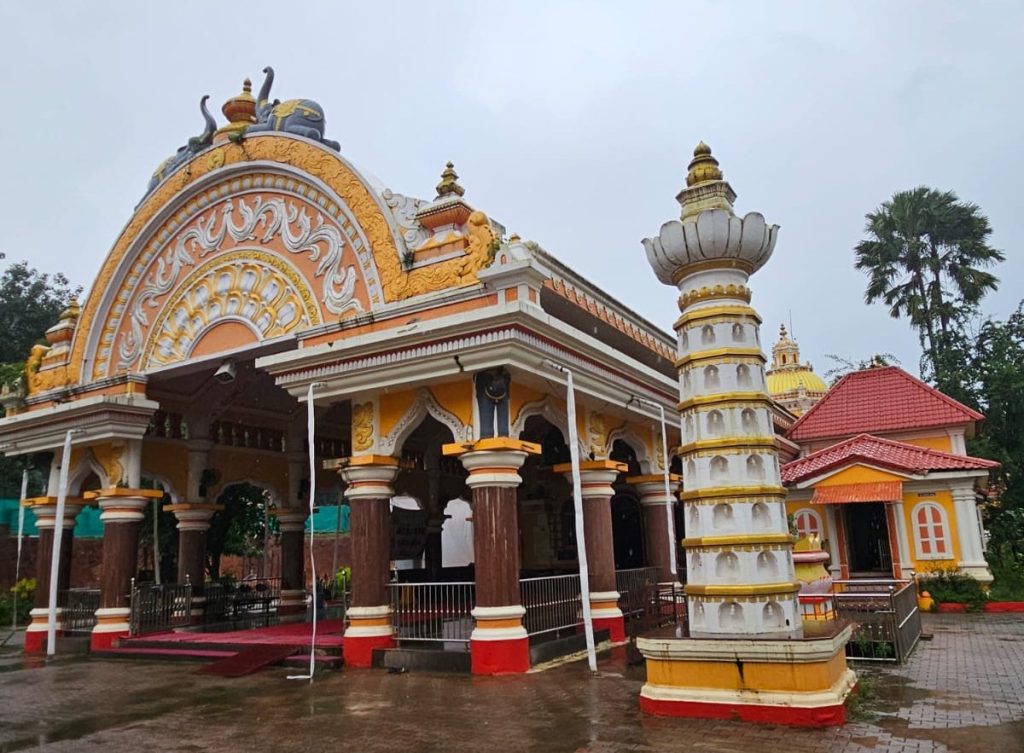
Bandoda is a village tucked away in a fold of green coconut palms and rice paddies, a short drive away from Kavlem.
Not as famous.
Not as bustling.
Quiet.
Necessary for the Mahalakshmi temple it houses.
She’s the ‘second stop’ for many GSB families who worship Her as Palavi, or the Protector. Never secondary, but not as visible.
The quieter mantle which holds everything.
The presence who lives within. Who straightens the spine and summons reserves of strength you didn’t know you possessed.
The temple has been recently renovated, and descending the steps leading to it feels like descending to a safe deck after sailing atop a swaying mast, buffeted by the thousand small
winds of everyday life.
A descent to warmth, to quiet, to peace.
The traditional ‘oti’ is again clutched safely in my hands.
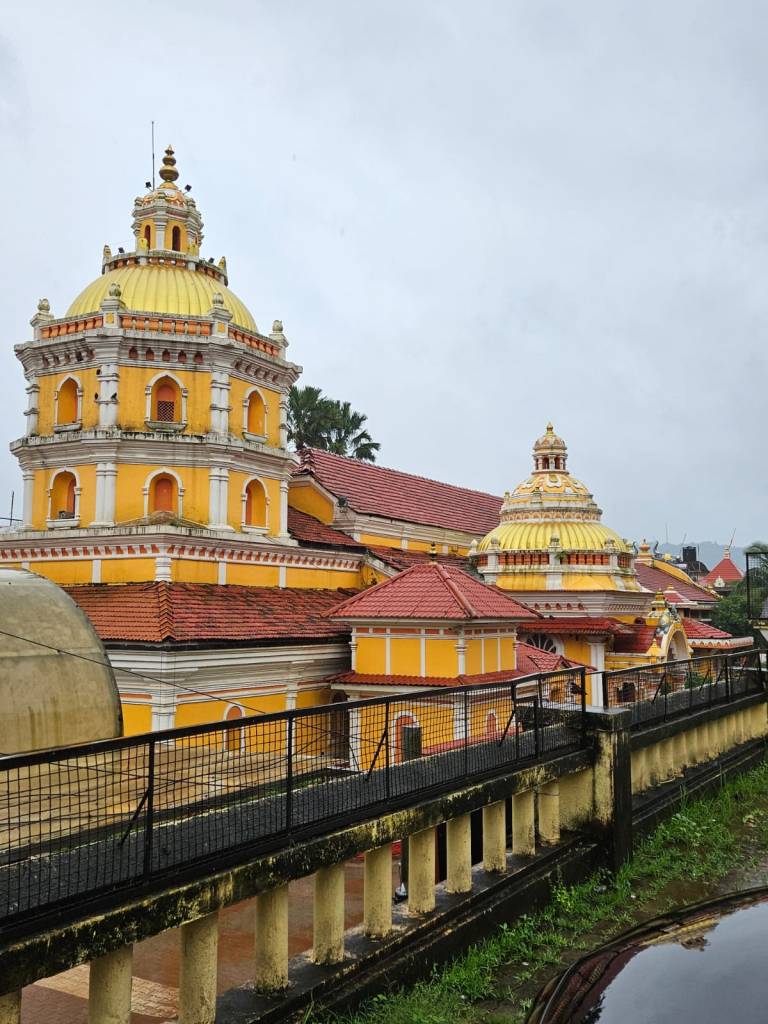
As I offer it to the priest, She looks back calmly, but firmly. There is none of the tempestuous emotion of Shantadurga. It is more of a settling, a calming, an exhale.
She’s always been Palavi: in both my maternal and marital homes. A thread of connection bridging the familiar and what was once foreign.
Dressed in all Her glory, She carries sword and shield and bears the Linga on Her crown.
An unusual and sattvic form of Shiva-Shakti.
The sanctum of this temple is unusual because it houses the original murti installed in Bandoda, as well as the ‘Panchadhatu’ one smuggled from Kolva during the Portuguese conquest by two devotees: Safto and Phato.
Two rice balls from the afternoon naivedya are offered to them as prasad on the instructions of the Goddess Herself. It is Her unique blessing and protection of those who risked everything for Her.
Come Mahashivaratri and Ram Navami, and She emerges in full glory, seated in a grand palanquin to be carried around the precincts in splendour.
And yet… as these details, part of family lore since childhood, return to me, I find myself thinking of the unlikely bandhan, or bond, to whicch She has been tied for aeons.
Protection is what She offers. And protection lies at the heart of one of our most cherished filial bonds. That between a brother and sister. A mutual one, born of love.
Legend says that after Mahabali was sent to Sutala as its ruler by Bhagwan Vishnu in His Vaman Avatar, Mahabali expressed a wish never to be separated from his Lord. Moved by his selflessness, devotion and honesty, Bhagwan took up residence as his gatekeeper in Sutala, leaving Vaikuntha and His spouse, Mahalakshmi, bereft.
Unable to bear this, She turned to Narad Muni for advice. Knowing that Bhagwan was bound by the threads of love, Narad Muni knew that He could only be freed by another bond just as strong.
And thus, She descended to Sutala disguised as a human, approaching Mahabali to tie an ordinary ‘suta’, or cotton thread, around his wrist. In one beloved tradition, that simple suta becomes a raksha sutra—a thread carrying the protection only love can provide.
Moved by this gesture, Mahabali accepted Her as a sister and told Her to ask for a boon. She revealed Her true form and requested him to return Her Husband, which he did.
But even when She returned, the protection She had invoked remained. And perhaps that is where the stories of Onam and Rakshabandhan are entwined: in the unlikely bond between a sister and brother, beyond blood, held together by mutual protection, trust and respect.
And as I took Her leave, this sense of protection settled like a quiet mantle around my shoulders, just as it had around those who carried Her to safety in tormented times.
It would soon emerge from my pen in the form of a story.
A story protecting memory.
Of what protection truly costs.
Of what truly mattered while saving a way of life. And every time I said, “Dharmo Rakshati Rakshitaha,” I would invoke her


Leave a Reply