Certain places hold sweet memories. They don’t awe or overwhelm, but are just as precious because they allow a return to what was always important.
Marcel (also called Mashel) is one such spot, about four kilometres off the Banastarim–Ponda road.
Blessed by the Mandovi, by a mother and by memory.
It houses a temple so unique that it is believed to be the original one of its kind in India.
Devaki Krishna.
A story of what motherhood means. Of what Vatsalya means even to a Divine child. And nowhere does motherhood seem more precious than in a story where it remained so painfully unfulfilled than in the story of Devaki, mother of the One who has enthralled so many: Krishna, the eighth avatar of Bhagwan Vishnu.
The familiar legend of Janmashtami celebrates the divine birth on a dark, moonless night in a prison in Mathura. Of the manifestation of Bhagwan as seen by Vasudeva and Devaki, His parents in that avatar: a four-armed form bearing Shankha, Chakra, Gada and Padma, the Kaustubh mani at His throat, the Shrivatsa mark, and the Vaijayanti garland adorning Him.
It speaks of Devaki pleading with Him to become a baby, her baby, so she may hold Him; to make Himself small so that the ever-lurking danger doesn’t find Him before its time. It speaks of the miracles thereafter: of chains falling away and Vasudeva crossing a raging Yamuna to bring Him to Gokul, to another set of parents who would raise Him until He was a young man.
But it rarely speaks of the mother left behind. Who held the one child allowed to her for a few moments more before she had to surrender Him to time and distance for His own safety, so that
He didn’t suffer the same fate as the six who had come before: snatched from her arms at birth and killed to prove a prophecy wrong; and the seventh, who had mysteriously disappeared from her womb.
Of a mother whose motherhood was more endurance than blessing, a thwarted dream which demanded far more than it offered: not even the simplest joys of holding, nursing, or rocking her baby to sleep. For whom it became an endless hoping and waiting.
And placing a laddu in the hand of a murti of the four-armed baby which she begged Vasudeva for, so that she could find the simple solace of a mother feeding her child.
Even when Krishna eventually returned to end Kamsa’s tyranny, His reunion with His birth parents was fleeting.
According to the Bhagwat Purana, Jarasandha’s army gathered at the gates of Mathura to avenge
his son-in-law’s death, not once, but seventeen times, turning what was to be a return home into a military campaign and later a resettlement in Dwaraka to prevent the decimation of a populace which trusted Him as their savior.
And Devaki waited.
Because the son whom she had once given up to protect Him had now returned as Protector of a people, and was no longer the infant her arms still remembered.
A few more years passed as Krishna built an army in Gomantak. But time has a strange way of folding itself when a mother’s heart can wait no longer.
And she met Him on Choodamani island on the Mandovi river. Perhaps her memory no longer served her well, perhaps her eyes blurred with tears, but her heart recognized the one whose heart had once beat within her.
And Krishna responded to one of the purest forms of Bhakti. The Vatsalya Bhav, which only wanted the best for Him, to protect Him, to keep the One who had saved so many safe. The one Bhav which flowed towards Him simply because He was her son.
Because how could He, who reads the heart of each devotee, not read the heart of a mother who wanted nothing but to mother Him?
He knew without being told that her arms ached because they had not carried the weight of His infancy, that strange infant-shaped space in her heart and the huge gap in her motherhood which only the smallness of an infant could fill.
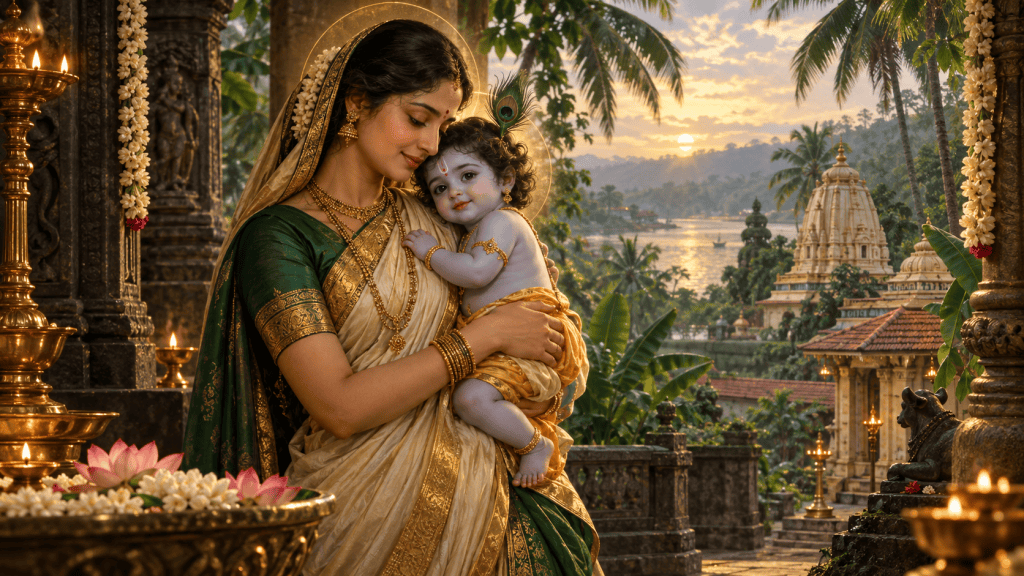
And the One who would one day manifest the vast Vishwaroop became an infant again. Straddling Devaki’s hip just as He was meant to.
No grand name, no announcements.
Just Devaki’s baby.
Devaki Krishna.
Local lore and oral historical accounts say that Devaki’s body remembered what it was to nurse her infant, and she did.
And thus, the murti: Devaki with her infant astride her left hip. It is said that the four-armed murti which had kept her company in the Mathura prison was later brought here and is still worshipped as the Utsav or processional murti.
This temple existed on Chodan (as Choodamani was later called) or Chorao island, until the Portuguese conquest. According to some Portuguese accounts, even Vasco da Gama knelt in the temple because he believed that it was a church of the Madonna and the infant Jesus. Perhaps a reminder that motherhood is universal and needs no introduction of faith.
However, with the beginning of the conversions, the murtis were moved first to Mayem in Bicholim, and later to Marcel where they now reside. Moved by devotees who knew that there could be no more separation of mother and child.
Several other temples, including Ravalnath, Mallinath, Bhoomika Devi (believed to be Yogmaya whom Vasudeva brought back from Gokul) and Daadsaakhal (Balaram bearing the Mausala), dot the complex.
The temple is also famous because of the annual festival of Chikhal Kalo on Ashadh Shuddha Dwadashi, a reminder of the mischievous games of the child Krishna. Perhaps there is a deeper meaning too: that once you embrace the earth, there remain no outward differences which normally mark us, as everyone frolics together in the sheer joy of being, a joy Krishna teaches us to embrace.
But standing in front of Devaki Krishna, one perhaps realises that the real miracle of motherhood is memory. Of the innocence of infancy, of a love so complete that even the Divine shapes Himself to fit a mother’s arms.
Because when Devaki holds Krishna in her arms, for one moment, the entire cosmos is held by motherhood.


Leave a Reply