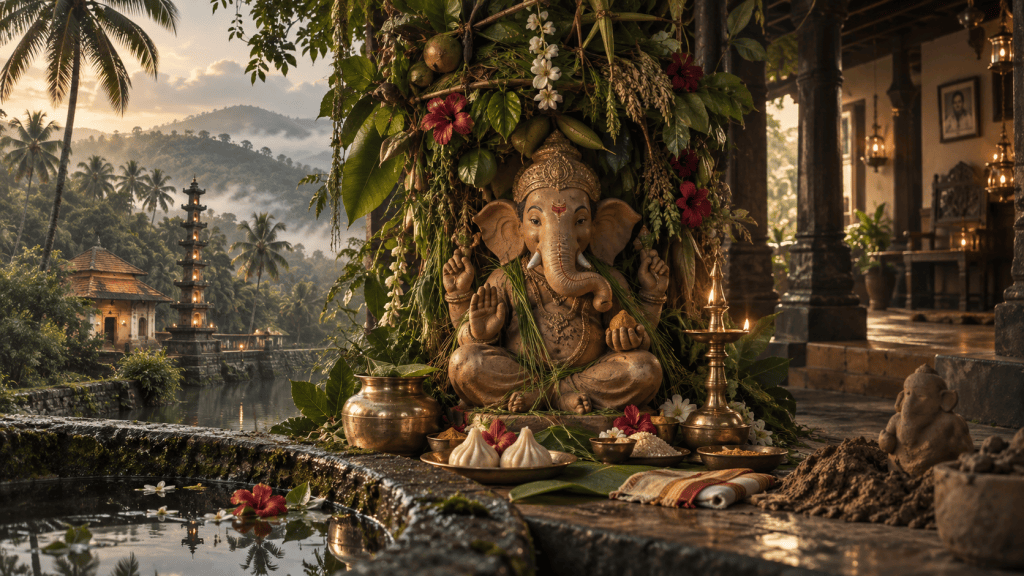
समस्तलोकशंकरं निरस्तदैत्यकुञ्जरं
दरेतरोदरं वरं वरेभवक्त्रमक्षरम् ।
कृपाकरं क्षमाकरं मुदाकरं यशस्करं
मनस्करं नमस्कृतां नमस्करोमि भास्वरम् ॥
I bow to the radiant One who brings auspiciousness to all the worlds and removes formidable obstacles; who bestows grace, forgiveness, joy and glory, and grants wisdom to those who bow before Him.
Thus writes Adi Shankaracharya in his Ganesh Pancharatnam.
Because beginnings, with their inherent fragility, need a special kind of grace. Fiercely protective and calmly nurturing, bestowing the knowledge to continue when needed and the wisdom to let go when it is beautifully complete.
And in this principle lives the God who is both childlike and controlled, student and seer, worldly and wise. Who visits year after year, changed in form perhaps but eternal in essence.
Ganesha.
Or Ganapati, as He is known in Goa.
Whose most famous temple here is in His all-encompassing form as Mahaganapati in the quiet village of Khandola.
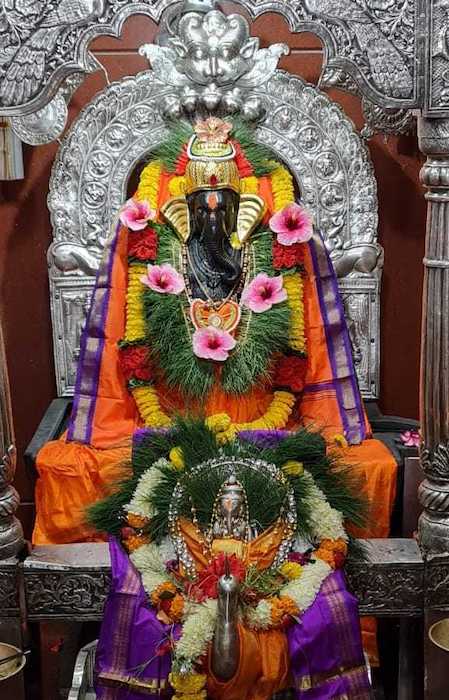
Whose story begins in creation but lives in the strange faith of the continuity of customs. Which makes sacred geography a living space instead of pointers on a map.
The Sahyadri Khanda of the Skanda Purāṇa describes Gomantak as a land of piety. Blessed by the intense tapas of those who chose it.
A famous legend recounts the penance which the seven great sages Vashistha, Vishwamitra, Atri, Gautam, Kashyap, Bharadwaj and Jamadagni performed on the island of Deepavati to propitiate Mahadev.
Pleased by the seven, He chose to appear as Saptakoteshwar.
However, local lore adds another layer: protection.
Hounded by demonic forces bent on disrupting their penance, the seven first turned to Ganapati, the Vighnaharta. Legend says He appeared at the highest point of Deepavati (now Divar), the supreme Sentinel keeping the dark forces at bay.
Since He manifested with His consort energy, He was also called Shakti Vinayak. And in His role as guardian, likened to Dhundi Raja Ganpati of Kashi.
Prince Lokaditya of the Kadambas also finds a mention in the Sahyadri Kanda for having invoked Him before establishing his kingdom here.
And so He remained, an intricately carved stone murti, attributed to the thirteenth-century style of the Hoysalas and Western Chalukyas.
Feted, loved and honoured until the boot of the Portuguese conquest tried to crush the local customs underfoot.
But some devotional customs belong to the river of continuity and flow on. And though the river altered its course, it did not dry up.
Because Mahaganapati was moved to keep Him safe: first to Khandepar, then to Narvem in Bicholim until He finally decided to reside in Khandola.
But the constant migration resulted in slight damage to His upper left hand. Tradition demanded that a flawed murti could not be worshipped, and a new one was consecrated in 1969.
But the Eternal who had outlasted the comings and goings of humans did not desire a break in the continuity. And thus, a member of the temple committee was subjected to a recurring dream in which he was told not to immerse the old murti on consecrating the new one. Bewildered by this, the committee chose to perform the Kaul prasad, the ritual where a falling petal indicates what must be done. The answer remained the same.
And the temple today, although boasting quite a few unique features, is also famous for two murtis in the sanctum sanctorum, the old one placed to the left of and slightly above the one which was consecrated in 1969 and is worshipped today.
The calm acceptance of the wear and tear caused by time.
A continuity through the presence of the old.
But it wasn’t only the murti which survived the march of time. Certain customs did too. Modified perhaps, but a testimony to a stubborn civilisation which believed in the sanctity of continuity.
When the foreign yoke sat heavy and open worship was forbidden, Ganapati again proved His presence in the collective consciousness. He migrated into homes and hearts and ate food fresh from the hearths.
He arrived when the season of growth had begun to ripen into plenty. A small idol made from local clay, installed lovingly on Bhadrapad Shuddha Chaturthi, bearing His name: Ganesh Chaturthi.
He accepted freshly harvested offerings tied around His idol, called the Matoli: a wooden framework where local flora, from the edible to the toxic, found a place. A small chain in the continuity of botanical knowledge. Entirely apt for the presiding deity of knowledge itself.
But some footsteps did not have the luxury of returning home to Gomantak, and they fled persecution by migrating over the Sahyadris.
To the place I still call home.
Belgaum.
Because sacred geography does not limit itself to a place. It roots itself wherever tradition is remembered, modified or followed intact.
The murti we bring home every Ganesh Chaturthi has always been the same: Ganpati astride a horse, felling an asura.
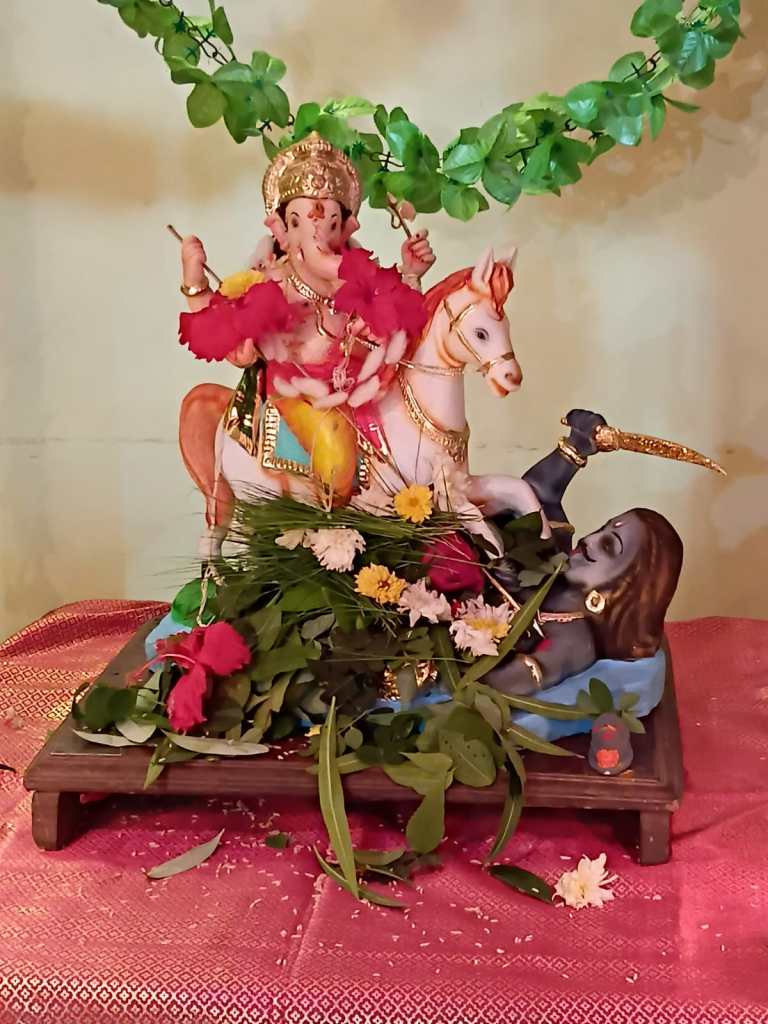
A reference in the Datta Mahatmya and Ganesh Purana says that Ganpati is astride a lion in Satyug, a peacock in Treta, a mooshak in Dwapar and a horse in Kaliyug.
Perhaps it is our way of honouring the memory of the distant ancestor who implemented the teachings of the scripture.
Even as we gather in the ancestral home, the same beloved festival spread prepared painstakingly, the same murti and the same aartis resounding in the same hall for the past 100 years, I know that we are a small part of the sacred geography Ganpati blessed us with.
The continuity of the custom, Khandola, Khandepar or Venugram as Belgaum was known then.
Because remembrance itself becomes part of the pooja.
And as the murti is immersed in the well in the backyard, “Pudhchya varshi lavkar ya” (come back sooner next year) seems truer than ever. Because He returns to the water, whether the depths of the well or the river bed, with the promise to return.
The clay is gathered again the next year, and a new idol is created to maintain continuity of a custom.
Because that is the teaching of Mahaganapati. That continuity lies both in the preservation of something worn by time and in the relinquishing of that which has completed its time so that new creation may occur.
And today, I realise that Khandola and Belgaum, separated by geography, still occupy the same sacred space.


Leave a Reply