वासांसि जीर्णानि यथा विहाय
नवानि गृह्णाति नरोऽपराणि ।
संयाति नवानि देही ॥ २.२२ ॥
तथा शरीराणि विहाय जीर्णान्यन्यानि
vāsāṃsi jīrṇāni yathā vihāya
navāni gṛhṇāti naro ’parāṇi
tathā śarīrāṇi vihāya jīrṇāny anyāni
saṃyāti navāni dehī
Meaning:
As a person sheds worn-out garments and wears new ones, likewise, at the time of death, the soul casts off its worn-out body and enters a new one.
This is Bhagwan Shri Krishna in the Bhagavad Gita, Chapter 2, Shloka 22.
A lesson not only in the inevitability of death, but also in the continuity of life. That past, present and future are not isolated. That memory is not completely lost, but remains beneath, shaping things to come. Because something of those who preceded us continues through us. The garment may end; the wearer does not.
And the most important lesson of all: to cling to the memory of the old garment is folly. But honouring what it was with open hands and an open heart is wisdom.
And a special day has been marked for this, falling in the sacred Pitru Paksha, the dark fortnight of Bhadrapad when the veil between what was and what is is at its thinnest. A time to remember, to honour and to let go with dignity and faith.
Indira Ekadashi.
The eleventh day of the waning moon of Bhadrapad.
A day offered to Narayan in the name of those who preceded us. When rituals performed with piety and purity gain so much power that they are capable of liberating not only us but also those who walked before.
The legend of Indira Ekadashi talks of the virtuous King Indrasen of Mahishmati, who was one day visited by the Sage Narad. Narad had a message of woe to convey: the king’s father had inexplicably failed to honour an Ekadashi vrat and, as a consequence, was condemned to reside in Yamaloka and suffer its travails. He begged his son to deliver him from them.
Deeply grieved by his father’s plight, Indrasen performed the vrat with complete purity and faith. Inspired by their king, his subjects too followed suit and, lo and behold, Indrasen was blessed by a vision of his father ascending to Vaikuntha and attaining liberation.
This quaint fable perhaps hides a deeper meaning than filial duty. Of not springing into being in a vacuum, but travelling where others who came long before have left markers: not merely genes, but their dharma, rituals, understanding of life and the hardships they bore to ensure continuity.
Like a channel carved out by the constancy and persistence of flowing water. Where yesterday’s water may have flowed on, but leaves traces for today’s water to follow. Where today’s water never meets what flowed before but is still blessed by the path it left.
It is the season of remembrance as the grain ripens in the fields. The season to remember the seed from which the crop has sprouted anew.
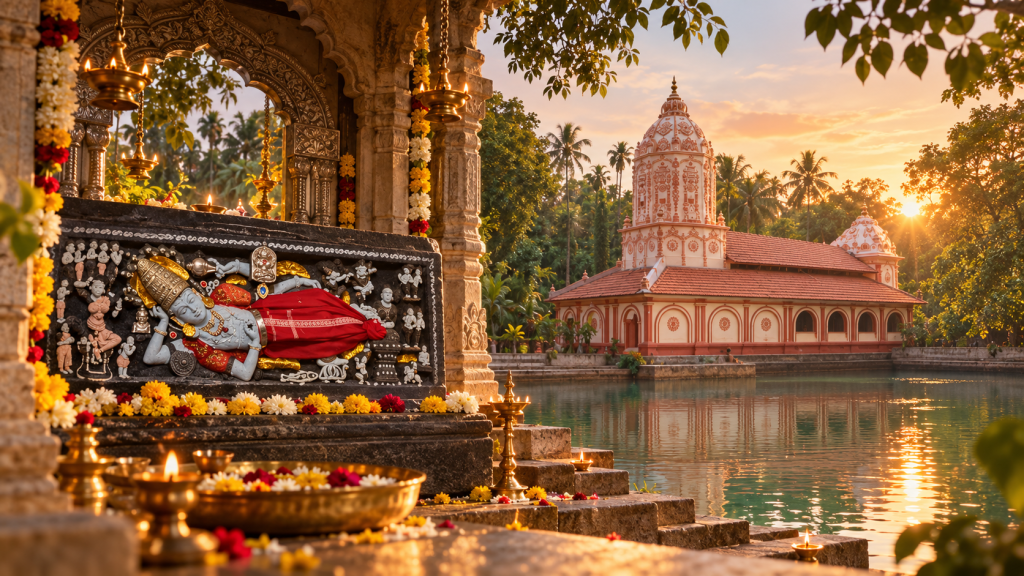
It is the day when Narayan is worshipped as Padmanabha. The One from whose navel sprouts a lotus containing Brahma Himself, carrying cosmic creation. Also known as Anant, the vast form, reclining tranquilly on Adi Shesha.
And in the quiet village of Savoi Verem in Ponda taluka is the temple of Madanant, a unique reclining form of Narayan, carved into a large stone slab and resting, as He usually does, in the middle of a water body.
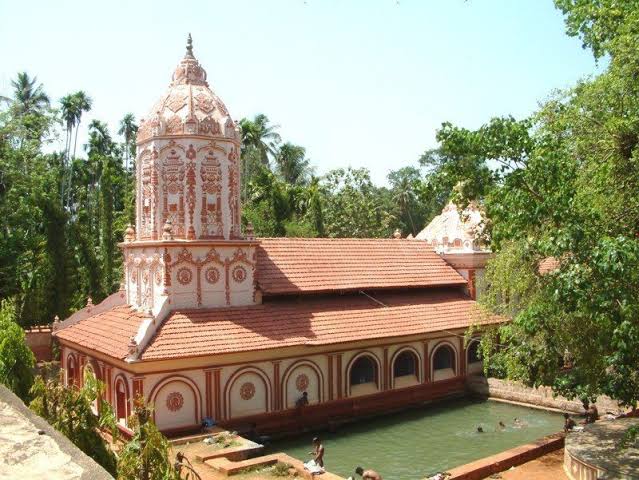
And He appeared here in a recurring dream to a local sanyasi. the Lord had arrived near the Mandovi river and was awaiting consecration. The sanyasi set out to seek Him, but all he found was a boat belonging to a Muslim trader, who claimed to have sailed all the way from Kathiawad, anchored at the banks. Much searching revealed nothing, as Islam forbids idolatry. However, a large stone measuring a good five feet by two feet, placed as ballast in the bow, caught the sanyasi’s eye. Turning it over, he was astonished to see the image of Madanant carved into it.
The stone was immediately moved to the river bank and installed in a shallow pool dug there, called the Pirachi Peth. Later, a temple was constructed and Madanant moved into the home He had ordained.
It is not just the murti, but the very construction of the temple, which makes it a bridge connecting past and future: it lies on raised plinths above a natural water body, which can be seen through a few openings in the temple floor.
The murti itself shows Narayan reclining upon Anant Shesh, with Brahma seated upon the lotus arising from His navel. At His head is Devi Lakshmi, with Hanuman below. His kirita has an idol of Shiva, and at His feet is Bhudevi, with carvings of the Dashavataras and the Saptarishis.
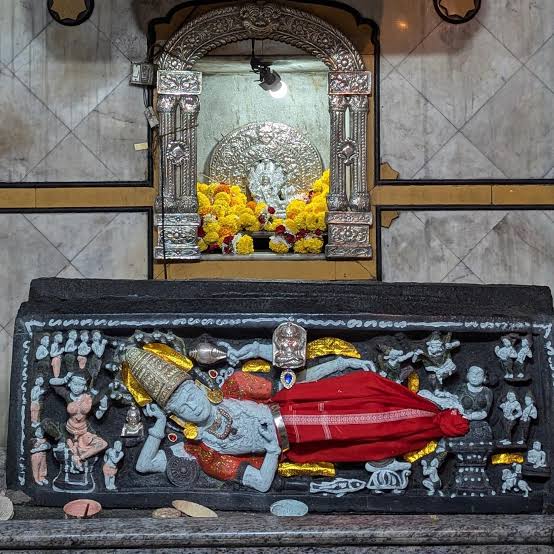
A unique anointing ritual of the idol with sandalwood paste depicts the Anant Roop clearly.
True to how He arrived here in a boat, the Sangod Utsav celebrated every year has the utsavmurti rowed through the temple tank in two canoes lashed together.
But standing before Him, one feels the eternal flow of continuity. Because just as He was discovered on turning over a stone, so also do we discover some parts of ourselves rooted in the past.
Not as desperate clinging, but as what remains after everything falls away.
And perhaps that is the true teaching of Pitru Paksha and Madanant: of continuum, of that which always remains. Of finite forms which are but parts of the unbroken whole.
The true promise of the past: Anant or the eternal.


Leave a Reply