Padmasana Sthithe Devi Parabrahma Swaroopini
Parameshi Jagan Mata Maha Lakshmi Namoostute
Meaning:
The Devi seated on a lotus in the Padmasana position, whose form represents the Supreme Being.
O Supreme One and Mother of the Universe, Mahalakshmi, I bow to You.
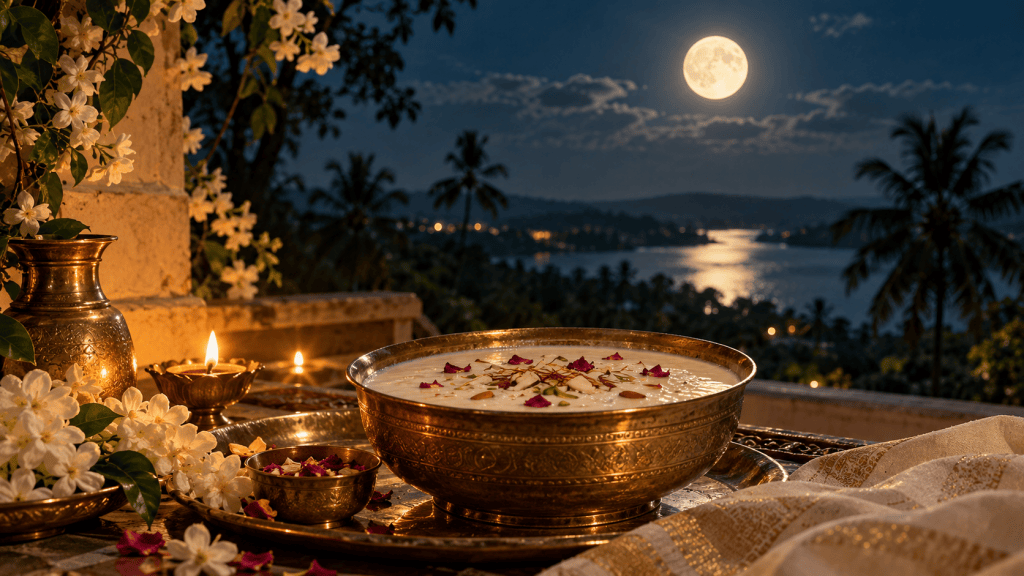
The season has changed, and the skies are clear. Moonlight pours in through open windows, keeping many awake beneath a spell woven from magic and memory.
It is Sharad Poornima, also called Kojagiri Poornima.
A night when the moon is said to be at its brightest, closest to the earth. A night luminous enough for the celestials to walk the skies asking, Ko jagarti? Who is awake?
For some, it is a night associated with the special blessings of Shiva and Parvati. But for many who remain awake to receive it, grace arrives as abundance and auspiciousness, through the blessings of Shree, the energy of the Sustainer of the Universe. A night of radiance placed at one end of a larger cycle, where abundance arrives not merely as possession, but as grace, awareness and the capacity to sustain.
The story of the Samudra Manthan speaks of such grace emerging from the churning of Kshirasagara, the Ocean of Milk. The tale itself is an ocean, holding within it many depths of understanding.
Indra, King of the Devas, was once presented with a garland of beautiful flowers by Maharishi Durvasa. He placed it upon the head of his elephant, Airavat. Irritated by the bees humming among the flowers, Airavat flung the garland to the ground.
An offering made with deep respect had been dishonoured.
Cursed by the sage, Indra lost the abundance that had fed his arrogance. Shree, with all the auspiciousness She embodied, withdrew into the ocean. And with Her went prosperity itself, the very gift of Swarga Loka. The asuras attacked, and the devas, driven from their city, sought refuge with Narayan.
Gently reminding them of the cause of their downfall, Narayan advised them to churn the ocean.
But the task itself demanded humility.
The devas had to recognise their limitations and ask the asuras for help. Mount Mandar became the churning rod, the serpent Vasuki the rope, and Narayan Himself, in His Kurmavatar, the base upon which the mountain could rest.
And the churning began.
What emerged first was not the long-awaited treasure of auspiciousness, but Halahala, the deadliest poison in the universe. Bhagwan Shiva intervened, holding it within His throat.
Then the treasures begin to arise.
One by one came the fourteen jewels of auspiciousness, culminating in the emergence of Shree, Lakshmi Herself.
And this night has been associated with Her ever since.
But the Manthan had yielded more than treasure.
It offered another lesson: before grace could emerge, one had to confront what was most dangerous and destructive without allowing it to become one’s identity. One had to endure the churn. One had to empty enough of the self to make room for grace.
And true abundance, perhaps, was not something to be seized through prowess. It had to be received.
Yet the story was still not complete.
Shree’s emergence did not mean a return to Amravati. This time, She would choose for Herself the one with whom She would unite Her energy of abundance.
The devas tried to propitiate Her.
So did the asuras.
So did the sages.
One presence, however, chose simply to respect Her will.
Narayan, the Preserver.
Her energy, which nourished and sustained creation, was the perfect complement to His function of preservation. And yet He stood apart, calm and self-contained. He demanded nothing from Her. He neither clasped nor claimed. He recognised Her for who She was.
And perhaps that was precisely why She chose Him.
They have been divine consorts ever since: the Sustainer and the Abundance.
Because abundance is what brings joy, beauty and fullness to sustenance.
Perhaps it is much like the flavoured milk offered as prasad on the night of Kojagiri. Milk can nourish perfectly well on its own, yet the spices and flavours deepen the experience.
Each completes the other.
***
If the Samudra Manthan is the story of a churn that moved the three worlds, Sharad Poornima cannot feel complete without the One many call the Purnavatara: Shri Krishna.
Where the devas received an external abundance through Shree’s grace, another kind of churning unfolded within the Gopis of Vrindavan.
Their longing, devotion and love for their beloved butter thief ripened into bliss, culminating in the Maha Raas, where Shri Krishna, as Ananda itself, danced with each Gopi individually and yet remained the still centre of their collective bhakti.
Movement around stillness.
Multiplicity around one centre.
A whirling circle of joy that remained complete within itself.
And perhaps this is why the season itself appears to come to fruition around Sharad Poornima: the full moon overhead, ripened crops in the fields, meadows alive with flowers, and water bodies carrying the promise of abundance into the months ahead.
Nature, too, seems to arrive at fullness.
***
But Shree is a sustaining energy, and sustaining energy cannot belong to one luminous night alone.
The moon wanes.
The nights grow darker.
And yet She continues to be worshipped when the month reaches its darkest threshold: Ashwin Amavasya, the night of Lakshmi Pooja.
Perhaps the abundance of Poornima has left behind enough light in the heart for darkness to be met differently.
And so, people light diyas.
Tiny flames against a vast night.
A reminder that light need not overwhelm darkness to transform it.
And here, the churn finally settles into completion.
Lakshmi, accompanied by a thousand lamps, becomes part of the light that welcomes an exile home after fourteen long years, to His beloved Ayodhya.
Chaos has not disappeared. It has been transformed. From churning to stillness and exile to homecoming.
Shwetambara Dhare Devi Nanalankara Bhushite
Jagasthithe Jaganmata Maha Lakshmi Namoostute
Meaning:
The One who wears white clothing and is adorned with jewels and various ornaments,
who preserves and protects the worlds, the Mother of the Universe, Goddess Mahalakshmi, I bow to You.


Leave a Reply