असतो मा सद्गमय।
तमसो मा ज्योतिर्गमय।
मृत्योर्मा अमृतं गमय॥
ॐ शान्तिः शान्तिः शान्तिः॥
— Brihadaranyaka Upanishad (1.3.28)Asato mā sadgamaya
Tamaso mā jyotirgamaya
Mṛtyor mā amṛtaṃ gamaya
Om śāntiḥ śāntiḥ śāntiḥ
Meaning:
Lead me from the unreal to the Real.
Lead me from darkness to Light.
Lead me from death to Immortality.
Om. Peace, peace, peace.
A prayer asking to be led to the final refuge of the soul: the Eternal.
And yet, beautiful as that promise is, the heart still longs to be completely received, for a place which holds without question. A place founded upon love and acceptance. A tiny earthly expression of that greater refuge
Home.
Where one is received as one is, a place to exhale. A place simply to be.
It is no coincidence, therefore, that there is a festival which celebrates the home: the home that awaits those who return, and the home they long to return to. A festival celebrated across much of the length and breadth of the land.
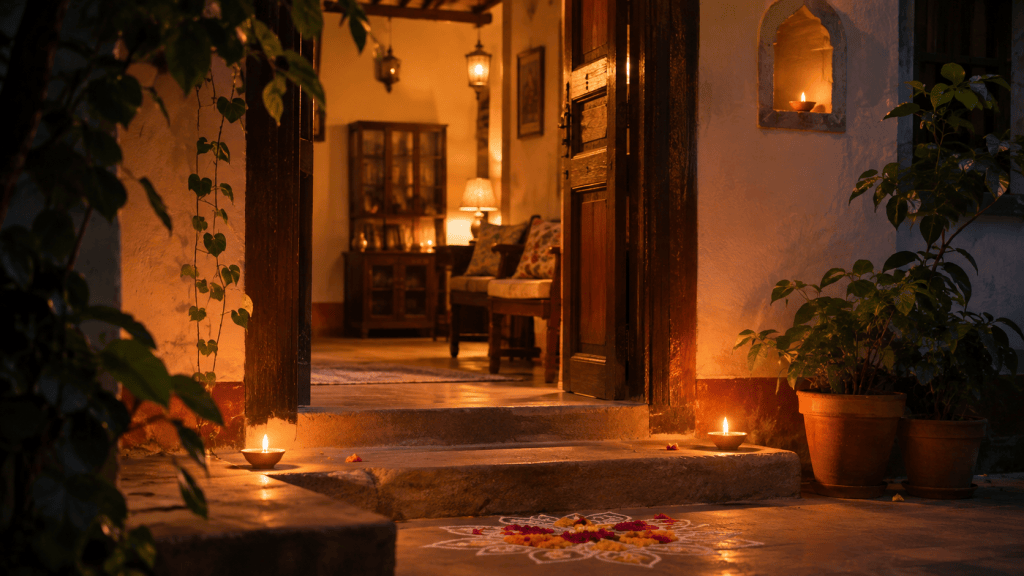
One that dispels darkness through the glow of a lamp. Each flame tiny in itself, yet together becoming a vast light.
A festival in which Bhagwan Vishnu, through the stories of two beloved avatars, transforms the place of simply dwelling to a place of belonging.
Diwali.
***
राम नाम मनिदीप धरु, जीह देहरीं द्वार।
तुलसी भीतर बाहेरहुँ, जौं चाहसि उजिआर॥
Meaning:
Shri Ram’s name itself is light, illuminating life from within and without.
But what happens when the despair of separation threatens to dim even the strongest flame of devotion?
In Nandigram, Bharat lived in self-imposed exile. He waited with devotion, faith and patience, while a single lamp burned. Weary of separation, exhausted by anticipation. The lamp burned steadily enough, but it was no longer enough for him. His love could no longer be bound by waiting.
And when Hanuman carried the news of his brother’s impending return, Bharat was overwhelmed. So was the citizenry of Ayodhya.
Their King, their Protector, their Swami was returning. The darkness of fourteen years had finally been dispelled, and light overflowed.
अवधपुरी प्रभु आवत जानी।
भई सकल सोभा कै खानी॥
The light rekindled within transformed Bharat’s solitary lamp into the thousands lit by the citizens across thresholds, streets, chowks, ghats, temples and bazaars. It was tenderness of a different sort.
The pure-hearted devotion of thousands who wished the light to guide their Beloved King home, lest He lose His way in the darkness of the Amavasya night. The devotion which knew full well that He was the Guide across the ocean of Samsara and yet wanted to guide Him into open homes and open hearts.
And return He did. To His city, where He was received into the warmth of simplicity and renewal of strength.
This was Ayodhya’s first Diwali: where the living memory of home became a beacon, and Shri Ram returned to those who had waited for Him.
Where Kanak Bhavan bore witness to the idea that even the Maryada Purushottam, could shed the constant mantle of responsibility and rule. Where He was received with the same compassion and tenderness which He had always given His people.
A place of being, a place called HOME.
***
But the story of divine homecoming does not end with Ayodhya.
Treta Yug turned to Dwapar, and the Ram Avatar returned as Shri Krishna.
Another way of teaching Dharma. Another way of leading the lost.
But the destination was still home.
***
कबीर यहु घर प्रेम का, ख़ाला का घर नाँहि।
सीस उतारै हाथि करि, सो पैठे घर माँहि॥
Kabir once described the house of the Lord as a place open only to those who enter in surrender
Nowhere does this feel truer than Dwaravati, or Dwaraka, on the shores of the Western Sea.
The capital built by Vishwakarma at the behest of Shri Krishna, in a single night, on land borrowed from the sea. It was intended to provide a safe home to the beleaguered citizens of Mathura, who had endured seventeen attacks by Jarasandha, seeking vengeance against Shri Krishna for the death of Kamsa, his son-in-law.
But even after Jarasandha was killed years later by Bhima, Shri Krishna’s cousin, Dwaraka continued to hear the desperate cries of the helpless who sought sanctuary with Dwarkadhish, as Shri Krishna was known
Far away to the east, in Pragjyotishpur, lived the demon Naraka. Believed to be the offspring of Bhagwan Vishnu in His Varaha avatar and Bhumidevi, he had been rendered nearly invincible by a boon declaring that he could only be killed only at his mother’s hands. He proceeded to unleash unprecedented mayhem, abducting sixteen thousand one hundred women and imprisoning them in his dungeons.
When he finally invaded Swarga Loka and stole the earrings of Aditi, the mother of the Devas, the cries of ‘Trahi, trahi’ reached a crescendo. Dwarkadhish went into battle with Satyabhama, believed to be the reincarnation of Bhumidevi and hence Naraka’s mother, at His side.
The inevitable happened, and Narakasura was slain on Narak Chaturdashi, also called Choti Diwali.
The prison doors were flung open. The Lord arrived as light for the women imprisoned within.
But they still cowered.
Freed from Naraka’s tyranny, certainly, but rejected by a cruel world. With no place to belong, with no place to call home.
But once the light arrives, even the darkest void must recede.
Shri Krishna heard their unspoken prayer for belonging, their unheard cry for sanctuary. And He accepted them all as His wives, safe in the haven of His protection.
It was a homecoming like no other. Sixteen thousand one hundred women were led out of the grim darkness in which evil had imprisoned them, into light, dignity and belonging. Where the Lord Himself became the light that illuminated the way home.
A place where no outcast lingered longingly at the threshold. Where Karunasagar did not allow a single tear of the helpless to go unanswered. Where the Sharanagati of the women imprisoned in Naraka’s dungeons became their sanctuary, with Shri Krishna Himself as their Beloved.
Diwali had become, in this telling, a festival of acceptance
***
Even today, Ram ki Paidi in Ayodhya is illuminated by thousands of lamps on Diwali. The hands lighting them may have changed, but the heart of the gesture remains: welcoming the Beloved home.
And Naraka is still symbolically annihilated in Goa through burning his effigies and the crushing of the karit fruit underfoot, both beloved traditions in Goa.
The homeward journey carried by these two avatars move in opposite directions across the land: Shri Ram from south to north, Shri Krishna from east to west. Yet both return to the same truth.
Sometimes the heart lights a lamp for the Lord. Sometimes the Lord becomes the lamp for the heart.
And on Diwali, perhaps, both lights meet at the threshold. A brightness which illuminates the home from without and within.
Making an earthly home a beacon of the Eternal.


Leave a Reply