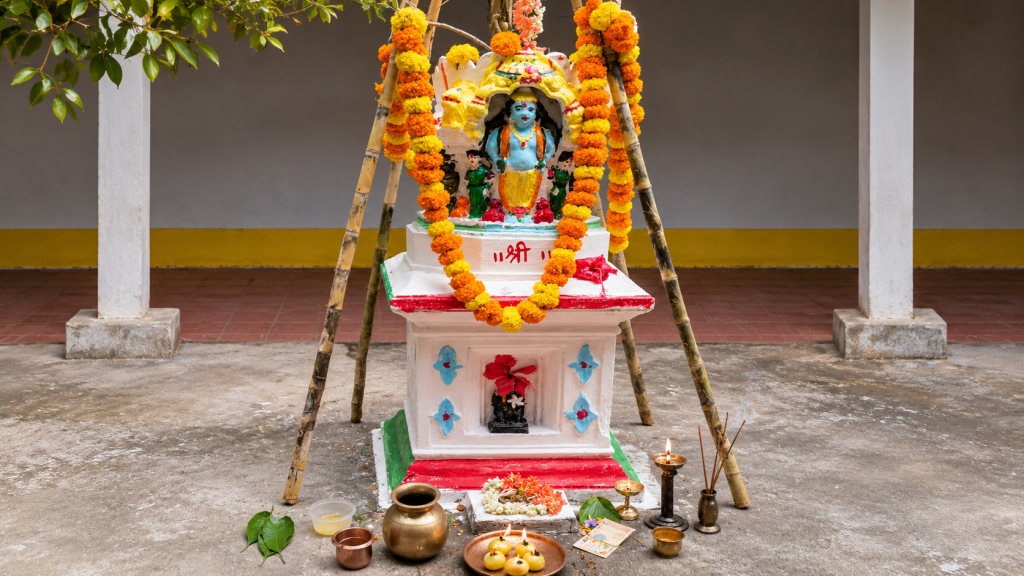
तदेव लग्नं सुदिनं तदेव ताराबलं चंद्रबलं तदेव ।
विद्याबलं दैवबलं तदेव लक्ष्मीपते तेऽङ्घ्रियुगं स्मरामि ॥
Tadeva lagnaṁ sudinaṁ tadeva tārābalaṁ candrabalaṁ tadeva |
Vidyābalaṁ daivabalaṁ tadeva lakṣmīpate te’ṅghriyugaṁ smarāmi ||
Meaning:
Recalling and meditating upon the lotus feet of Lord Vishnu (the husband of Goddess Lakshmi) brings about the most auspicious moment (lagna), the most auspicious day (sudina), and bestows the strength of the stars (tārābala), the moon (candrabala), knowledge (vidyābala) and divine grace (daivabala).
Beloved words, chanted at the conclusion of the Mangalashtaka, heralding the union of two souls in matrimony. A journey that begins with meditation at the feet of Bhagwan Vishnu, in the belief that every moment offered to Him is sanctified by His purity.
Come Kartik, and the very earth seems to awaken to auspiciousness, hope, trust and the joining of hearts. It marks the beginning of the ‘wedding season’, especially in Central and Western India. But what has given the institution of marriage such importance since ancient times?
Of the four ashramas described in the Dharmashastras, Grihastha, or the householder stage, occupies a unique place, marked by both responsibility and fulfilment. One strives to pursue and balance three of the four purusharthas: Dharma, Artha and Kama, thus paving the way for Moksha through a life fulfilled in both duty and desire. Not alone but with a companion, a spouse, in a relationship founded on trust.
And perhaps that is why the season itself begins with the wedding of the One who renders everything auspicious: Bhagwan Vishnu, with Vrinda. And what an incredible story it is of deity and devotee, of means and consequences, and of trust violated and restored.
Long ago, there lived a powerful Asura king named Jalandhar. Born of the fiery energy of Bhagwan Shiva’s third eye, which fell into the ocean, he was raised by Varuna, the God of the Oceans, and mentored by Shukracharya, the Asura Guru. He was married to the chaste and pious Vrinda, a devotee of Bhagwan Vishnu. Her chastity and devotion formed a powerful armour around Jalandhar, rendering him invincible.
Thus protected, Jalandhar was not content merely with defeating the Devas. Marching to Kailash, he cast covetous eyes upon Mata Parvati and attempted to charm Her by assuming the form of Bhagwan Shiva Himself.
Outraged by his attempt to deceive Her, Mata Parvati invoked Her Brother, Bhagwan Vishnu, requesting that Jalandhar, too, be brought down through deception. Meanwhile, Jalandhar challenged Bhagwan Shiva, who battled him but was unable to slay him because of the protection afforded by Vrinda’s devotion.
Bhagwan Vishnu was faced with a painful decision: to betray the trust of a devotee in order to stop adharma, which was inadvertently being protected by a wife’s dharma.
Assuming Jalandhar’s form, Bhagwan Vishnu appeared before Vrinda. Believing Him to be the victorious Jalandhar, she embraced Him, thus breaking the vow that had protected her husband. On the battlefield, Jalandhar lost his protection and was slain by Bhagwan Shiva.
Vrinda was heartbroken, not merely by her husband’s death, but even more by the deception of the One to whom she had offered her deepest devotion: her Aradhya, Bhagwan Vishnu.
The anguish of a grieving wife and a devastated devotee mingled in a curse: ‘Oh Vishnu, whom I have prayed to all my life, yet who chose to destroy my trust with a stony heart, may You become stone. May You know the pangs of separation from Your beloved Spouse.’ With that, Vrinda immolated herself.
Bhagwan Vishnu knew that Vrinda’s curse arose from a heart He had hurt and a trust He had broken. He accepted it with complete humility and blessed her: ‘Devoted and pious Vrinda, no pooja of Mine will ever be complete without your presence.’
And then, the Tulsi plant was born of her ashes and Bhagwan Vishnu became Shaligrama, the sacred stones found in the Gandaki River of Nepal. He, who accepts everything a devotee offers with complete devotion, whether prayer or curse, allowed the second part of her curse to unfold in the Treta Yuga, when He incarnated as Shri Ram and was separated from Mata Sita.
To this day, no pooja of Bhagwan Vishnu is considered complete without the offering of a Tulsi leaf. Moreover, as a blessing for her lifelong devotion and steadfastness, Bhagwan Vishnu, as Shaligrama, is married to Vrinda, as Tulsi, every year. The auspicious period begins on Kartik Shukla Dwadashi and lasts until Kartik Poornima. Thus, this beautiful story marked by the breaking of trust ends with a deity who willingly accepts the consequences of His actions and transforms them into another blessing.
The significance of such offerings lies not merely in the ritual itself, but also in the continuity of the beliefs that sustain it. I explored a similar relationship between faith, inherited customs and cultural memory in one of my earlier essays, Mahaganapati of Khandola: Of Creation, Customs and Continuity.
And perhaps Tulsi Vivah marks the beginning of the wedding season because its story conveys one of the fundamental principles of Grihastha Ashrama: accepting responsibility without evasion. Not merely for one’s actions, but also for their consequences because in a chosen relationship such as marriage, trust must not only be given but also accepted as something precious, something to be protected irrespective of the path the marriage may take.
That is the lesson of Shaligrama: that the stillness of acceptance becomes the foundation upon which trust may grow, again and again.


Leave a Reply